Datapath Aetria Brings Multi-Deck Visual Control to RRS Sir David Attenborough
Contributor

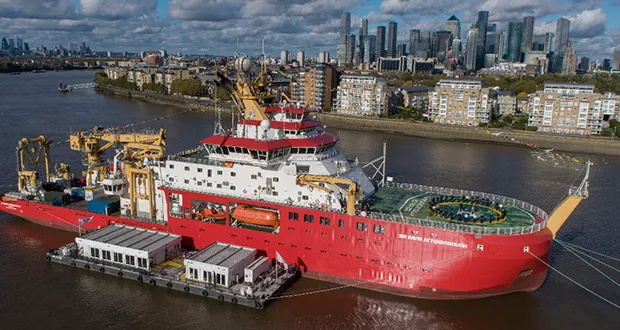
The RRS Sir David Attenborough is not a corporate boardroom. It is a polar research ship run by the British Antarctic Survey (BAS), with science, navigation, and ops spread across decks that do not forgive flaky video paths. BAS needed distributed displays, operator seats, and video walls that still behave when the ship is working ice in the Arctic or Antarctic.
Datapath’s Aetria platform — workstations plus VSN-series wall controllers — was selected to pull that visual control together. The brief was mission ops, not a show floor demo: shared sources, KVM reach, and multi-window walls that local teams can still drive without calling a single “control room hero.”
Multi-Deck Reality, Not a Single Wall
Ships make AV hard for boring reasons: cable runs, vibration, limited rack space, and operators who cannot all sit in one suite. BAS needed centralized awareness with local access — science spaces and ops positions seeing the same high-value sources without daisy-chaining consumer extenders.
Aetria workstations and VSN controllers were specified to add 4K streaming, IP-based source switching, and flexible multi-window layouts across large displays. Design work with Datapath happened before the final onboard integration so the architecture matched the vessel’s environment, not a lab floorplan.
What Actually Went Into the Rack
The published install mix is concrete enough to matter on a bid:
- Four VSN300 systems as operator-focused visualization platforms
- VSNMicro 600 units on decks five and eight, plus a VSN V3 for higher 4K output density
- Six Image4K graphics cards, 17 IQS4 IP video splitters, 12 VisionSC-A2 capture cards, three ActiveSQX2 encode/decode cards
That is a modular KVM and wall path, not a single all-in-one box. If one science campaign needs more captures or another needs more wall outputs, you grow the layer that is short — you do not re-buy the whole ship system.
Commissioning at Headquarters, Then at Sea
Datapath ran commissioning training at BAS headquarters before the vessel’s return to UK waters after Antarctic work. Operators learned the hardware and software on land first. Remote support covered the multi-deck cutover so the jump from classroom rack to shipboard ops was not a cold start in a rolling lab.
For integrators, that sequence is the playbook: train before the vessel (or building) is live, stage configs, then support the on-site bring-up with people who already know the UI under pressure.
Why the Modular Bet Matters
BAS can add IQS4 splitters, VisionSC-A2 captures, or ActiveSQX2 modules as missions change. That is the commercial argument as much as the technical one. Polar science does not wait for a five-year AV refresh cycle, and neither should the control plane.
Integrator tip: on multi-room or multi-deck control jobs, write the BOM as layers (capture, process, wall output, KVM) with spare slots called out. Clients understand expansion when you show which card cage grows without touching the rest of the system.
Tags
Discussion
Sign in to join the discussion. Vote, reply, and follow industry conversations.
Loading comments…