
Esports venues continue to expand their display counts, often running 40 to 80 screens across player stages, spectator bowls, and broadcast trucks. Most of these rooms already use 10 GbE backbones, yet the combination of 4K60 feeds, instant-replay servers, and camera cuts still pushes aggregate bandwidth past comfortable limits. ZeeVee’s ZyPer4K encoder running firmware 3.x now lets technicians pick chroma subsampling at encode time rather than forcing a single fixed profile.
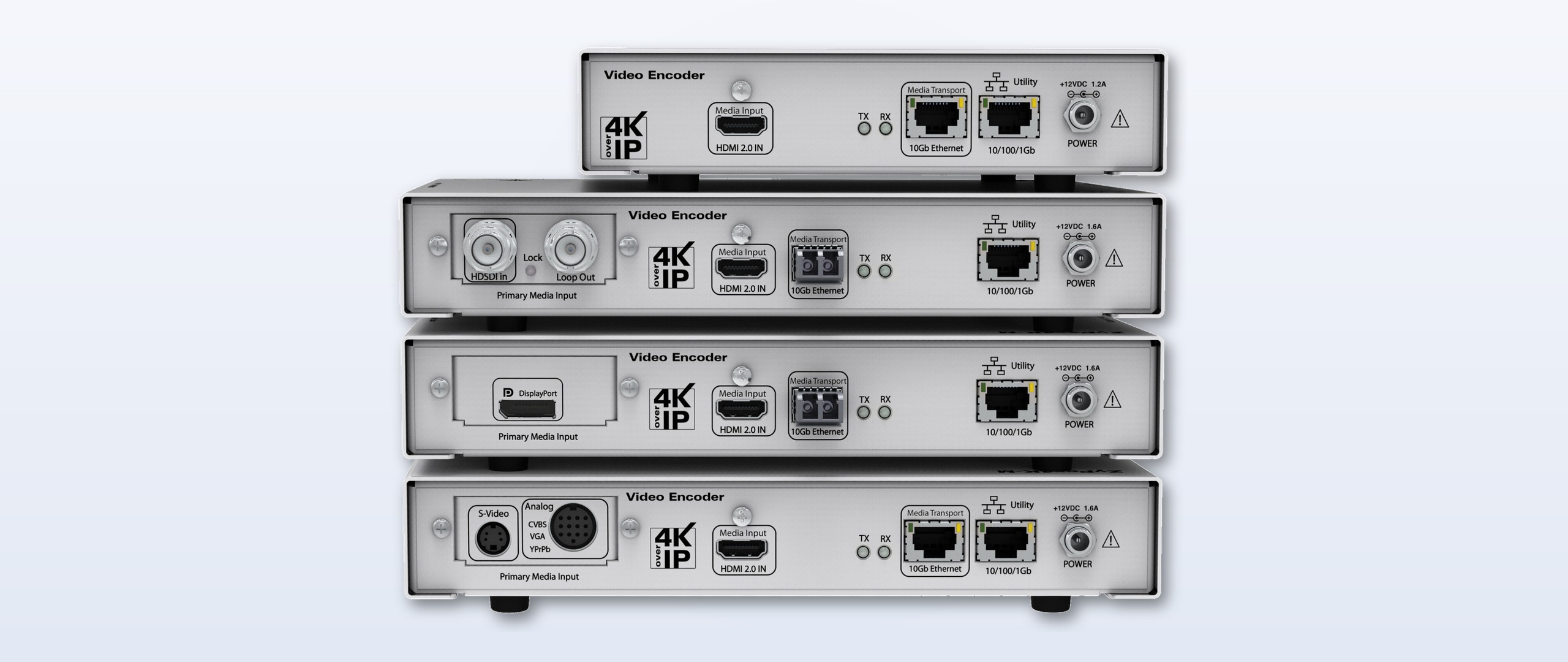
The encoder itself stays the same hardware: a compact 1 RU box with dual 10 GbE SFP+ ports, HDMI 2.0 input, and analog audio embedding. What changed is the JPEG2000 compression engine. Firmware 3.x exposes three selectable modes through the existing ZeeVee Management Server interface: full 4:4:4 at roughly 850 Mb/s, 4:2:2 at 620 Mb/s, and a 4:2:0 fallback near 480 Mb/s. Latency remains under 60 ms end-to-end when paired with the matching ZyPer4K decoder, but the bandwidth delta lets an integrator stay under the 70 % utilization rule that most switch vendors recommend for multicast traffic.
Practical Configuration Steps During Commissioning
Installers report that the quickest workflow starts with a baseline test using the 4:4:4 preset on a single encoder feeding two decoders. A portable 4K reference monitor connected to one decoder shows whether game HUD elements and sponsor logos hold edge definition. If the measured switch port load exceeds the planned headroom, the encoder is switched to 4:2:2 via a one-line API call or the web UI; no reboot is required. Most teams keep a short macro in their control system that toggles the mode based on time-of-day presets, dropping to 4:2:0 only during non-critical sponsor loops.
Power and cooling numbers stay consistent across modes. The encoder still draws 28 W typical, so an eight-unit rack consumes the same 225 W whether chroma is full or reduced. What does change is switch port licensing. A 48-port 10 GbE managed switch with 40 GbE uplinks can reliably handle 22 ZyPer4K streams at 4:2:2 versus only 16 streams at 4:4:4. At current street pricing that difference equals roughly $3,800 per switch chassis, a figure that multiplies quickly in a 200-encoder arena.
Color-critical checks remain the installer’s responsibility. Esports titles such as Valorant and League of Legends use saturated accent colors that clip noticeably under 4:2:0; technicians therefore reserve that mode for secondary confidence monitors rather than main stage walls. When the signal path includes a video processor for bezel compensation or rotation, the processor must also be set to accept 4:2:2 input or the subsampling advantage disappears at the final scaler stage.
Forward-looking deployments will likely combine these firmware options with emerging 25 GbE edge switches already appearing in new arena RFPs. Once those switches reach volume pricing, the same ZyPer4K chassis can shift back to 4:4:4 on more streams without new encoder hardware, giving owners a clear upgrade path that protects the original encoder investment.
Integrators who have already deployed ZyPer4K systems can apply the firmware update through the management server in under ten minutes per unit, with no change to existing EDID or HDCP handshakes. Early adopters at two North American collegiate arenas report that the 4:2:2 preset reduced their multicast subscription count by 28 percent while preserving readable text overlays on the main stage wall. One venue also uses the API to poll real-time bandwidth and automatically steps down to 4:2:0 when spectator-bowl occupancy drops below 60 percent, freeing headroom for visiting-production trucks that occasionally join the same VLAN.
Because the encoder still ingests full 4:4:4 HDMI 2.0, downstream devices that require higher chroma can simply request a separate stream; the hardware supports up to four simultaneous multicast addresses from a single input. This flexibility eliminates the need for duplicate encoder racks that some facilities previously installed to serve both “production” and “venue” displays. ZeeVee has published a simple JSON schema so that house control systems can query each encoder’s current subsampling mode and receive an acknowledgment within 200 ms, allowing show-critical cues to confirm chroma settings before doors open.

Field service teams note that the only recurring support ticket involves source devices that output limited-range RGB; enabling the encoder’s “full-range passthrough” flag restores correct black levels regardless of the chosen subsampling mode. With these tools now shipping, arena designers can standardize on a single encoder SKU and still meet both pixel-perfect and budget-conscious requirements across an entire season.


