
Mid-market conference rooms between eight and twenty seats now represent the largest volume segment for Q-SYS deployments. These spaces typically combine a pair of 75-inch displays, three to six table microphones, wireless presentation, and USB bridging to a laptop for Teams or Zoom. Integrators report that the two fixed-I/O Q-SYS cores most often quoted in this segment are the Core 110f and the Core Nano, yet the two units differ enough in I/O density and DSP allocation that swapping one for the other changes both hardware cost and commissioning hours.
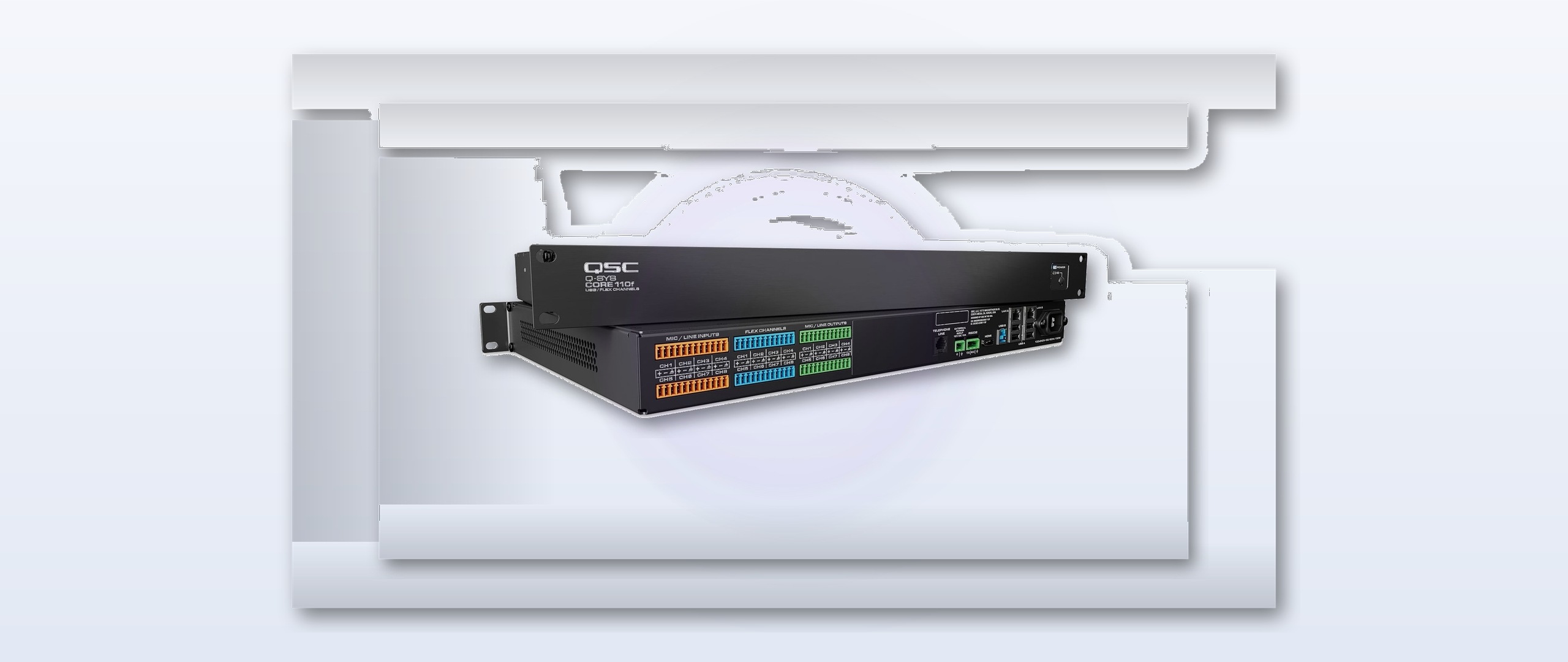
The Core 110f supplies eight mic/line inputs and eight line outputs on the rear panel plus an eight-channel USB audio interface. It also carries a built-in 10-port PoE switch. The Core Nano, by contrast, offers only four mic/line inputs and four line outputs along with a four-channel USB interface and no internal switch. Both processors run the same Q-SYS Designer 9.x firmware and support identical control scripting, yet the 110f maintains roughly 40 percent more available DSP cycles once AEC, dynamics and matrix mixing are loaded.
Channel Count and Physical Constraints in Practice
Installers default to the Core Nano when the room contains four or fewer wired microphones and a single display. In those cases the processor fits inside the credenza alongside the amplifier and network switch, eliminating a second rack shelf and cutting termination labor by roughly three hours. The lower per-unit price also improves margin on competitive bids. When the same room later adds a second display or a ceiling microphone array, however, the Nano’s four analog outputs force an external Dante breakout or a second processor, negating the original savings.
The Core 110f becomes the clearer selection once six microphones, two displays and a USB 3.0 soft-codec connection are required. Its eight outputs allow direct analog feeds to left and right amplifier channels plus independent program and record mixes without consuming Dante subscriptions. The internal PoE switch further removes the need for a separate eight-port injector, a line item that otherwise appears on every Nano job. Field data from three national integrators shows average commissioning time for a Core 110f room at 14 hours versus 11 hours for the Nano, but the 110f configuration avoids a $1,800 Dante I/O box and two hours of custom scripting when the client later requests an overflow space tie-line.

Programming workflow remains nearly identical for both cores. Designers begin with the same blank project template, drag in the chosen core, and assign AEC instances to the physical inputs. The only material difference appears in the GPIO and serial port mapping; the 110f exposes eight GPIO pins while the Nano provides four. Integrators therefore maintain two separate but parallel device templates rather than rewriting control code for each project.
Looking ahead, the arrival of 8K displays and higher-channel beam-forming arrays will push more rooms past the Nano’s I/O ceiling within the next two model years. Integrators are already standardizing on the Core 110f for any conference space whose architectural drawings show six or more table boxes, treating the Nano strictly as a cost-optimized option for the simplest four-seat huddle rooms that show no growth path on the plans.
Integrators often pre-configure the Core 110f USB audio interface for bidirectional 8-channel routing to a room PC, mapping channels 1-4 as far-end audio returns while reserving 5-8 for local program and recording feeds. This layout reduces USB cable swaps during hybrid meetings and keeps the soft-codec client stable under Windows 11 Teams certification tests.
With the Core Nano, technicians frequently add a compact Dante stage box for the fifth and sixth microphones, assigning static IP addresses inside Q-SYS Designer before the site visit. The extra device requires a separate PoE injector and one additional managed switch port, items that appear on every bill of materials once the design exceeds four analog inputs.
Field teams report that loading the same AEC instance count on the 110f leaves headroom for two extra virtual mixing busses used in overflow linking, whereas the Nano hits DSP limits after basic matrix and dynamics processing. Firmware version 9.4.1 introduced improved GPIO event handling on both cores, yet only the 110f exposes enough pins to drive independent tally lights for each display without external relays.


