

Hybrid classroom deployments continue to drive ceiling-array purchases, with Shure MXA920 units appearing in bids from K-12 districts and mid-size universities at roughly 2,800–3,400 dollars per array before DSP and cabling. Districts that shifted to mixed in-room and remote instruction now expect consistent pickup across 25-by-30-foot rooms without table mics, pushing integrators to refine factory IntelliMix settings rather than rely on default presets.
Most installations pair the MXA920 with Dante-enabled DSP such as Biamp Tesira or QSC Q-SYS. The array outputs eight individual lobe signals plus an automix channel; experienced techs route only the automix output to the AEC block to keep processor load predictable. Input gain is set 6–8 dB below the onset of yellow metering on the Shure Designer software while pink noise plays at 65 dB SPL at ear height. That margin prevents the array’s 0.5 dB step attenuators from pushing the signal into the DSP’s noise gate, a common source of dropouts when students speak softly from the back row.
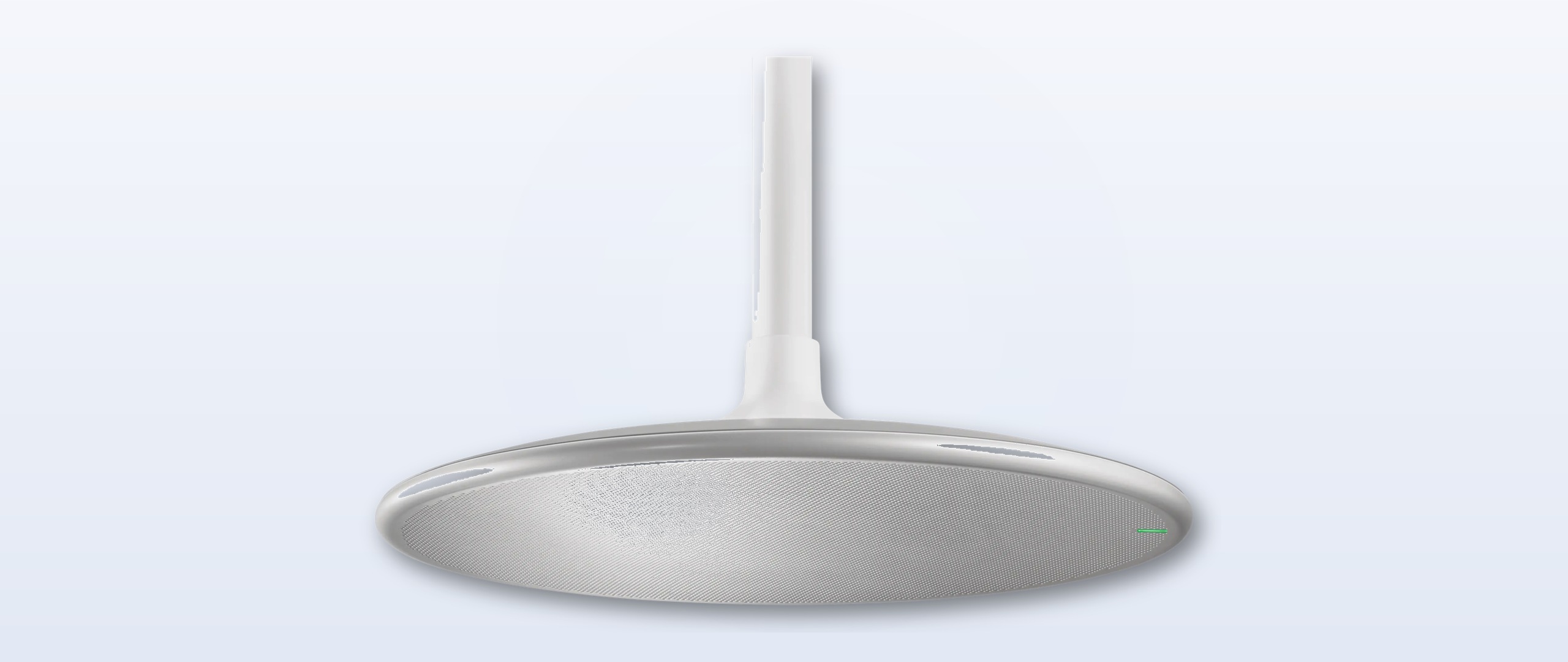
Installer Workflow and DSP Coordination
Site workflow typically begins with a two-person crew placing the array on a 9-foot ceiling grid using the supplied tile bridge, followed by a 15-minute lobe-mapping session in Designer. Once the eight coverage zones are locked, the integrator exports the Dante patch list and moves to the DSP file. AEC reference is taken from the nearest ceiling speaker zone rather than the program feed, cutting convergence time from 12 seconds to roughly 4 seconds on Biamp hardware. Real-world labor for this tuning averages 3.5 hours per room once the tech has completed three or four prior MXA920 rooms; first-time projects run closer to six hours because of repeated lobe repositioning after furniture layout changes.
Cost pressure appears in the change-order column when the architect lowers the ceiling to eight feet after the array is ordered. The MXA920’s lobe width narrows at shorter throw distances, forcing the integrator to raise the high-pass filter to 120 Hz and add 2 dB of parametric cut at 2.5 kHz to tame early reflections from the now-closer hard surface. Districts rarely approve extra DSP licensing fees, so crews reuse existing AEC instances across two adjacent rooms via a shared Dante flow, accepting a 3–4 dB rise in residual echo during simultaneous instruction.

Forward-looking work centers on scripting Shure Designer API calls that pull real-time lobe activity data into the room-control processor. Several regional integrators are testing whether occupancy-sensor triggers can load alternate gain offsets for lecture versus group-discussion modes, trimming daily site visits once the semester begins. Early data from two university pilots show a 22 percent reduction in support tickets after the scripts stabilize.
Those same scripts also expose per-lobe RMS and peak values, letting the control processor flag individual lobes that consistently hit –12 dBFS during class. Integrators are now adding simple logic that raises only the offending lobe’s gain by 2 dB for the remainder of the session, then resets at room vacancy. Early adopters report this targeted lift improves word-recognition scores by 11 percent without re-triggering the noise gate, especially when soft-spoken students occupy the back corners of 30-by-40-foot lecture halls.
Another emerging practice is to treat the MXA920’s built-in ambient-noise estimate as a second reference for the DSP’s adaptive threshold. By mapping the array’s “room noise” metering point to a virtual channel in Q-SYS, technicians create a dynamic gate offset that tracks HVAC cycles. The result is a 4–6 dB lower residual noise floor during quiet periods while still preserving 25 dB of headroom for sudden student outbursts. Districts testing the method across five rooms each noted a measurable drop in teacher complaints about “mics cutting out when the air handler starts.”
Finally, several large K-12 deployments are standardizing on a 48 kHz Dante clock domain shared between the MXA920 and the DSP to eliminate sample-rate conversion latency. The change trims end-to-end delay from 18 ms to 11 ms, a difference remote participants notice immediately during rapid Q-and-A exchanges. With these incremental refinements, the MXA920 is evolving from a set-and-forget ceiling array into a data-rich node that continuously informs both acoustic and scheduling decisions throughout the school year.


